
In the modern American home, the dining table is much more than a place to eat. It is where we host holiday marathons, help children with late-night homework, and share the "big news" of our lives. Because this space serves as the emotional center of the household, the lighting should do more than just illuminate the tabletop—it should create a ceremony.
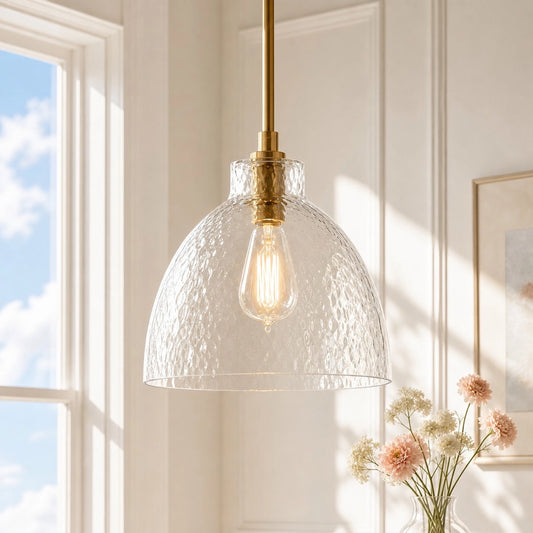
As a lighting specialist with five years in the field, I’ve noticed that people often treat dining lighting as an afterthought. They install a standard fixture and call it a day. But if you want a room that invites people to linger long after the dessert plates are cleared, you need to think about the "glow." A piece like the Vale Farmhouse Hammered Glass Dome Pendant Light is a perfect example of how texture and design can transform a simple Tuesday night dinner into an event.
The Psychology of Lighting: Why 'Ceremony' Matters
Have you ever noticed how your mood changes when you walk into a candlelit restaurant versus a brightly lit fast-food joint? That is the power of intentional lighting. A "ceremonial" dining space uses light to signal to the brain that it is time to slow down, connect, and enjoy.
To achieve this, your lighting needs to create a focal point. In an open-concept home, the dining table can often feel like it's "floating" in a sea of space. A strong visual pendant acts as an anchor, pulling the room together and defining the boundaries of the gathering area. By choosing a fixture with a unique texture, such as hammered glass, you add a layer of visual "sparkle" that feels celebratory without being overly formal.
1. The Rule of Scale and Proportion
The first step in creating a ceremonial feel is getting the scale right. A tiny light over a massive oak table feels disconnected and weak. Conversely, a fixture that is too large can feel oppressive. The general rule of thumb is that your light fixture should be about 1/2 to 2/3 the width of your dining table.

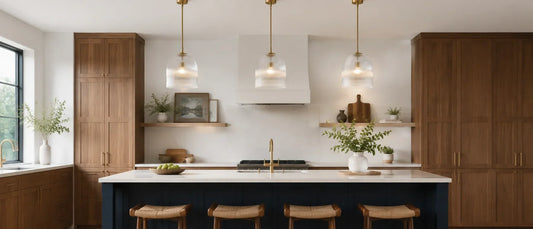
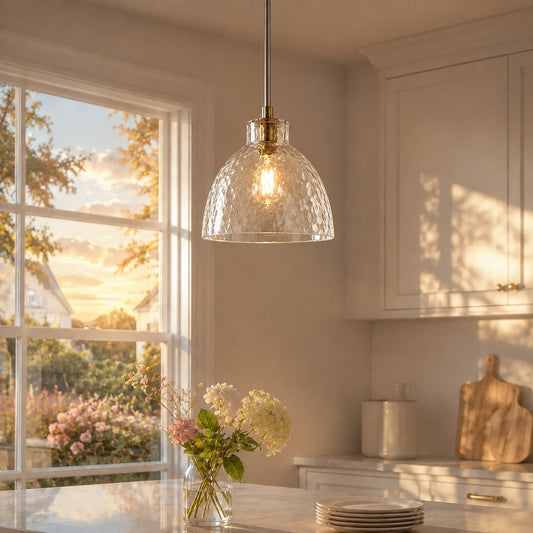
For a standard rectangular farmhouse table, a single large dome or a pair of pendants works beautifully. The Vale Farmhouse Hammered Glass Dome Pendant Light offers a generous silhouette that provides enough "weight" to ground the table while the glass material keeps the room feeling airy and light.
Further reading:How to Choose the Right Pendant Light Size
2. Mastering the Hanging Height
Height is where the "drama" happens. If you hang a light too high, you lose the sense of intimacy. If it’s too low, you’re staring at a bulb instead of your guests. To create that "ceremonial" cocoon, aim for the bottom of the fixture to sit 30 to 36 inches above the tabletop.

This height creates a "pool" of light that focuses purely on the table and the people sitting around it. It creates a sense of privacy—a room within a room. When the light passes through a hammered glass surface, it scatters slightly, softening the shadows on people's faces and making everyone (and the food) look better.
3. The Importance of Texture: Why Hammered Glass?
In lighting design, "flat" light is boring. To create a sense of occasion, you want "dynamic" light. This is why I frequently recommend hammered glass over clear glass for dining areas. Clear glass is beautiful, but it can be harsh.

The "hammered" effect on the glass acts like a thousand tiny prisms. As the light hits the dimples, it creates a gentle, dancing pattern on the walls and the table. It mimics the flicker of candlelight. This subtle movement is what creates the "ceremony." It feels alive and artisanal, suggesting that the items in your home were crafted with care rather than mass-produced in a factory.
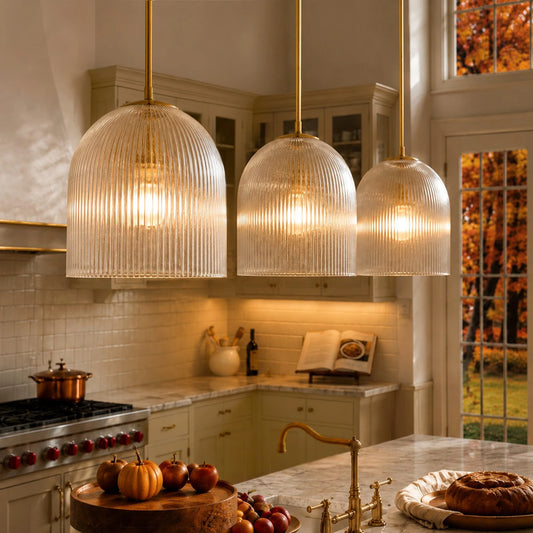
Further reading:Design Approaches for Clustered Glass Lighting Fixtures
4. Layering for the After-Dinner Mood
A ceremonial dining room shouldn't rely on just one light source. While your main pendant is the star of the show, you need supporting actors. Consider adding low-level "mood" lighting, such as battery-operated candles on a sideboard or soft wall sconces.

When you use a dimmer switch with your main pendant, you can transition from "Homework Mode" (bright, clear light) to "Dinner Party Mode" (warm, low glow) in a second. Because the Vale Pendant uses high-quality glass, it handles dimmed light beautifully, maintaining its clarity and glow even at the lowest settings.
5. Creating the 'Glow' on the Table
The way light hits your dinnerware is part of the ceremony. Imagine a holiday feast where the light catches the edge of the wine glasses and the silver. Textured glass fixtures enhance this effect. By choosing a dome shape, the light is directed downward onto the "stage"—your table—ensuring that the center of the room is the brightest part, which naturally draws people in.

Conclusion: Make Every Night a Celebration

Choosing the right lighting for your dining room is an investment in your family's quality of time. By focusing on scale, height, and the unique texture of your fixtures, you can turn a functional room into a sanctuary for connection. The Vale Farmhouse Hammered Glass Dome Pendant Light is more than just a lamp; it is a centerpiece designed to bring a sense of ceremony to every meal you share. Don't just light your home—illuminate your life's best moments.
Tags:
Vorherige
The Heart of the Home: Living Room Lighting Design Inspiration and Matching Tips
Nächste
The Heart of the Home: Optimizing Chandelier Styling and Light Performance in Dining and Kitchen Areas