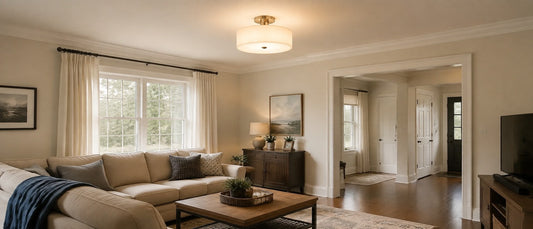

In my five years of consulting for high-end residential projects, I’ve found that the single most common mistake homeowners make isn’t choosing the wrong style—it’s choosing the wrong scale. A light fixture that is too small for a room looks like an afterthought, lost in the vastness of the ceiling. Conversely, a fixture that is too large can make a space feel cramped and claustrophobic.

Scale is the secret language of interior design. When you get the proportions right, the room feels "balanced." You don't necessarily notice the math behind it, but you feel the harmony. Today, we’re going to strip away the guesswork and give you the exact formulas used by professionals to ensure your lighting—like the stunning Daisy Classic Polished Brass Pendant Light—fits your home perfectly.
The "Room Proportion" Rule
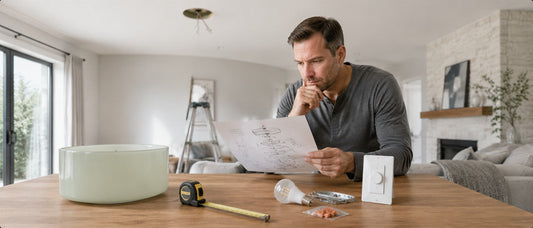
If you are looking for a pendant to hang in the center of a room (like a bedroom or a small seating area), there is a very simple mathematical trick. We call it the "L+W" rule. Here is how it works:
- Measure the length and width of the room in feet.
- Add those two numbers together.
- The sum is the ideal diameter for your light fixture in inches.

For example, if your room is 12 feet by 14 feet, the sum is 26. This means you should look for a pendant roughly 26 inches wide. This ensures the fixture has enough "presence" to anchor the room without overwhelming it.
Further reading:How to Choose Lighting Based on Room Size
Proportions Over a Dining Table
When hanging a pendant over a dining table, the rules change. Here, the fixture isn't competing with the whole room; it’s competing with the furniture. The goal is to create a "visual canopy" that makes the dining experience feel intimate.

A good rule of thumb is to choose a fixture that is 1/2 to 2/3 the width of the table. If you have a 48-inch round table, a pendant with a 24-to-32-inch diameter is the sweet spot. The Daisy Classic Polished Brass Pendant Light, with its timeless dome shape, works exceptionally well in this configuration because its polished surface reflects the table setting, adding to that sense of occasion.
The "Visual Weight" Factor
Mathematics only gets you 90% of the way there. The remaining 10% is about "visual weight." Not all 20-inch pendants are created equal. A 20-inch pendant made of clear glass feels "lighter" and smaller than a 20-inch pendant made of solid polished brass.

Because the Daisy Classic features a solid, high-shine brass finish, it has a high visual weight. This means it commands attention. If your room is very minimalist or has a lot of white space, a brass fixture will "feel" larger than its physical measurements. Keep this in mind: if you love the bold look of polished metal, you can sometimes afford to go slightly smaller than the formula suggests because the color itself does so much work.
Further reading: How Lighting Transforms Everyday Living
Height Matters: The Vertical Dimension
Sizing isn't just about width; it’s about where the light sits in your vertical space. For standard 8-foot ceilings, the bottom of the pendant should generally hang 30 to 36 inches above a surface (like a table or island). For every additional foot of ceiling height, you can add 3 inches to that gap.
If you are hanging the pendant in a hallway or entryway where people will walk under it, you must ensure at least 7 feet of clearance from the floor. This is a safety non-negotiable. Large-scale pendants in an entryway act as a "statement piece" that sets the tone for the entire home, and choosing a classic finish like polished brass ensures that the "first impression" of your home is one of warmth and luxury.

The "Paper Test": A Pro Tip
Before you commit to a purchase, I always recommend the "Paper Test." Take a piece of cardboard or even some balloons and tape them together to match the dimensions of the pendant you are considering. Hang them from the ceiling with some string. Walk around the room. Sit at the table. Does it feel like it’s in the way? Does it look puny? This physical mock-up is the best way to visualize how a 3D object will occupy your specific space.
Conclusion: Investing in Balance
At the end of the day, lighting is the most important piece of furniture in your home because it affects how everything else looks. By following these formulas for room proportion, table scale, and visual weight, you can shop with confidence. If you’re looking for a fixture that combines classic proportions with a finish that never goes out of style, the Daisy Classic Polished Brass Pendant Light is a masterpiece of balance. It provides the perfect focal point for those who value both precision and elegance.
Tags:
Previous
Pendant vs. Flush Mount: Which Lighting Suits a Minimalist Home?
Next
The Evolution of Elegance: 2026 Glass Pendant Light Market Trends and Buying Guide