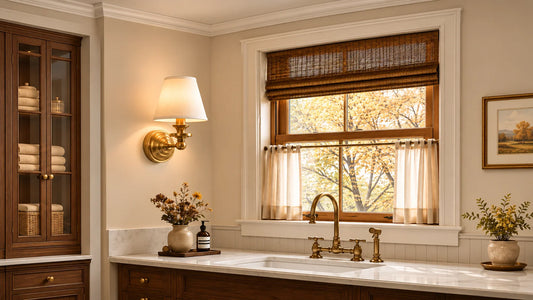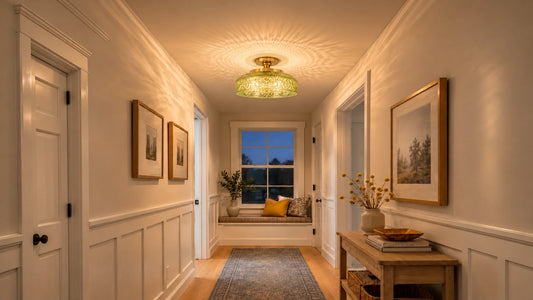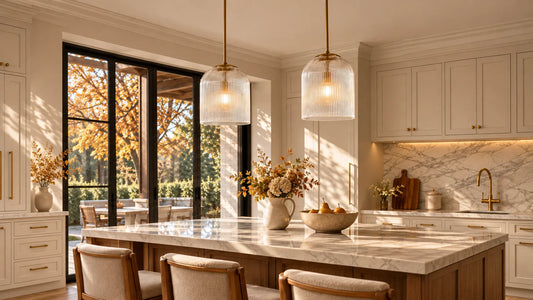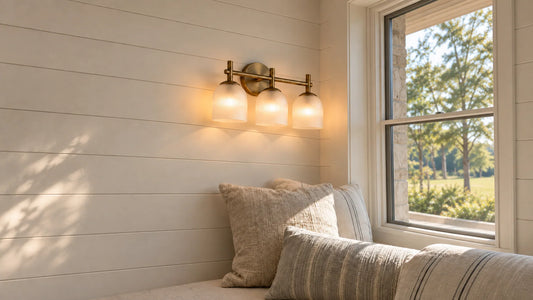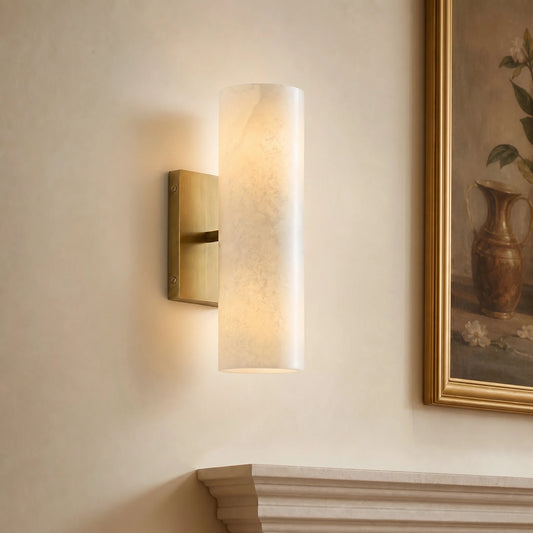
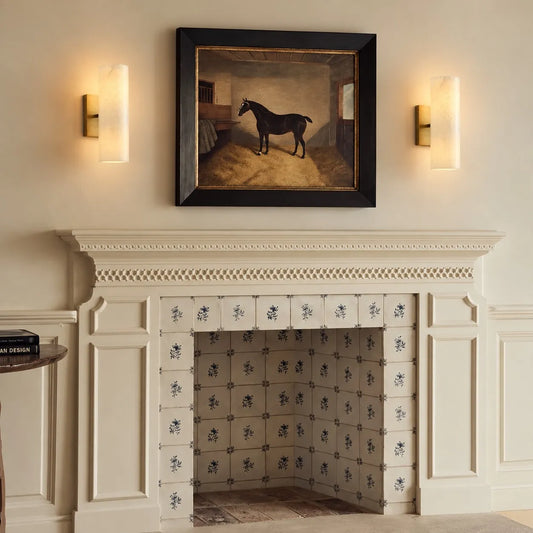
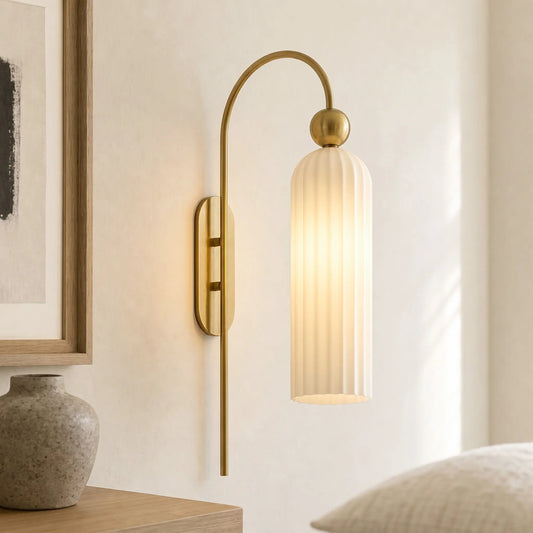
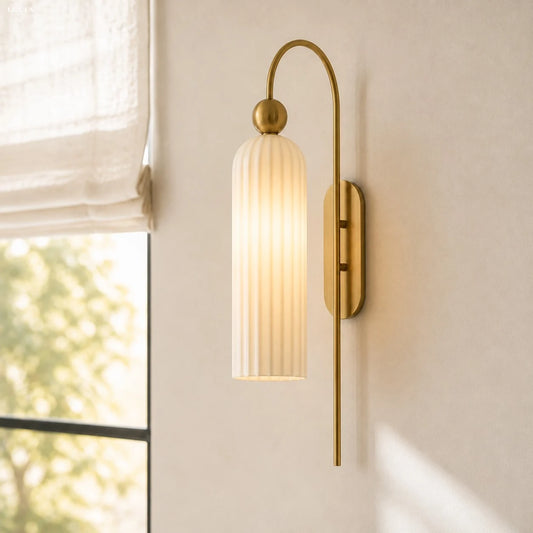
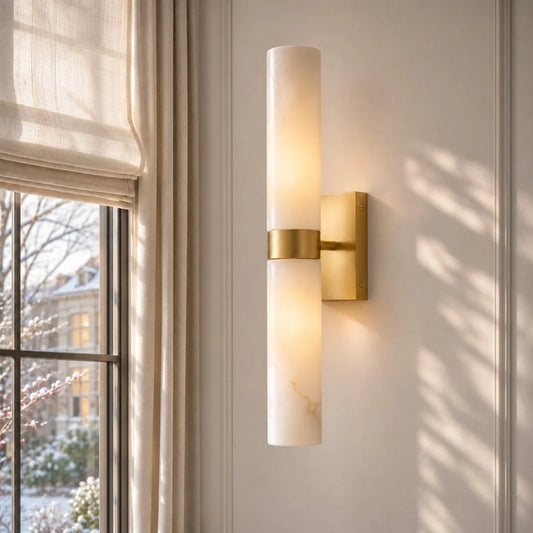
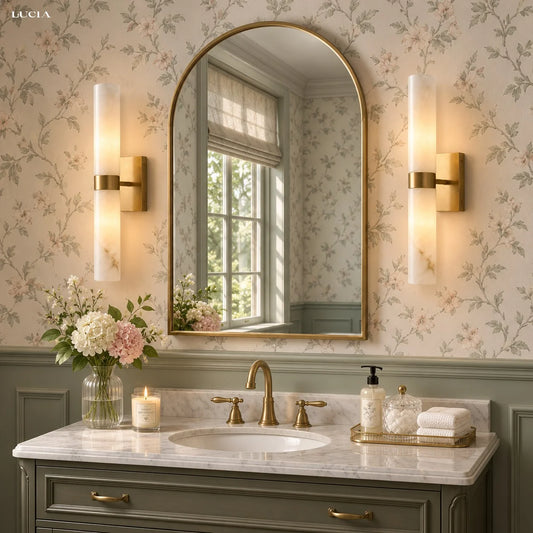

For a quiet wall, this Art Deco fluted glass bar is your one statement piece.
The ribbed glass and round medallion supply all the ornament. Keep surrounding decor simple; busy surfaces will bury the lamp’s elegant geometry.
This 23.25” statement bar works best above a defined anchor: artwork, a sideboard or cabinet. Hanging it over an empty stretch of wall feels unfinished. Keep in mind: when paired above artwork, it is decorative accent lighting, not vanity lighting for faces.
Vintage Art Deco Milk Glass Eloise Vanity Light Fixture
01 — The wall
One pattern, then stop
The Vintage Art Deco Milk Glass Eloise Vanity Light Fixture is the example, not a style to spread across the room. It is a hardwired two-light bar. The page describes twin fluted shades and a round ornamental backplate. That is already a collected object. Common Interior Design Mistakes When Mixing Natural Materials is the related warning: wood, glass, and metal can pile up until none of them reads.
The living-room photo is the quieter case. Green glass and Black metal sit on a plain wall, centered on a wood cabinet. One glass color, one metal on the fixture, one piece of furniture under it. The dining photo is the busier case. Green glass and Brass sit on a patterned wall, above a painted sideboard, with patterned chairs in front. The page shows that as a dining corner. It still tells you the limit: if your wall is already this patterned, do not add a third metal story around the bar. Brass, on this product, is meant to meet warm frames and hardware once, not every object in the room.


02 — The base
Something has to sit under the 23-inch bar
The only listed size is 7.5″ high by 23.25″ wide, projecting 5.5″. An older diagram shows about 23.6″. Order the listed option, not the diagram. Tape 23.25″ on the painting, the cabinet, or the mirror. What to Put on an Awkward Empty Wall: When a Wall Sconce Actually Works asks for that relationship. A bar with no base is just a fixture on a blank wall.
23.25″Width
7.5″Height
5.5″Projection
The mirror, painting, or cabinet is narrower than 23.25″. The ends pass it. Stop.
The clear wall above that object is under 7.5″. The bar cannot fit. Shades touching the frame fails. The page publishes no extra air gap.
Two separate mirrors. One bar cannot serve both. The page says one fixture per mirror, each electrical point centered.
Glass and metal combinations currently list at $278. Alabaster with Brass or Black lists at $748. Every listed shade uses this one size. The metal does not: Brass and Black vary by shade, and Clear Glass is currently Brass only. Check the live options before you order.


03 — The glass
Color is the second pattern, so spend it once
White milk glass is the shade the page describes as softening the bulb. It is the calmer glass when the wall should stay quiet and the medallion can be the detail. Green, pink, blue, and lavender glass are the color note. Clear Glass is Brass only, and the page does not say it softens the bulb. If you need the bulb softened, do not assume clear glass does that job.
Alabaster lists at $748, not $278. Veining will differ from shade to shade. Keep stone shades dry. If the faucet and mirror frame are already Brass, the backplate is the second Brass note. Stop there.
04 — The limits
A quiet wall still needs a real installation
The page does not publish a mounting height. Do not borrow one from another sconce. Tape 23.25″ by 7.5″, centered on the object below, clear of the frame and the ceiling. Projection is 5.5″. Walk past it with a bag. A turned shoulder fails it. A clear run shorter than 23.25″ cannot hold the bar.
It is hardwired, not a plug-in, and not a ceiling light. An electrician shuts the breaker off and confirms the connection, orientation, and clearance. Two E26 bulbs are sold separately, 40W maximum each, and they must fit inside the shades. Listed U.S. voltage is 110–120V. Dimming is listed only with dimmable bulbs and a compatible dimmer, confirmed together. No lumen figure is published, so this is a wall layer, not the light for the whole room.
05 — Before you order
Five checks, short answers
Will the coloured glass fade over time?
The tinted glass is kiln-coloured and will not fade under normal indoor use.
Are replacement fluted glass shades available separately?
Individual spare shades are not sold; the fixture comes as an assembled whole unit.
Does alabaster stone need special cleaning?
Wipe gently with a dry soft cloth. Avoid water, spray cleaner and harsh chemicals.
What if I want to use it above a narrow mirror?
Not recommended. The ends will extend past the mirror and break the balanced styling.
Can this light be used in a shower area?
Keep it away from splashing water and shower steam.
Tags:
Vorherige
Does Your Bathroom Feel Bare at Night? Try a Short Vanity Wall Bar
Nächste
A Stone Sconce Looks Settled by Day. It Starts Working After Dark.